
"Seeing is believing," is an oft-quoted and usually iron clad truth. However, when Elspeth McGillicuddy witnesses what she believes is a murder, can she (or anyone else?) believe what she thought she saw?
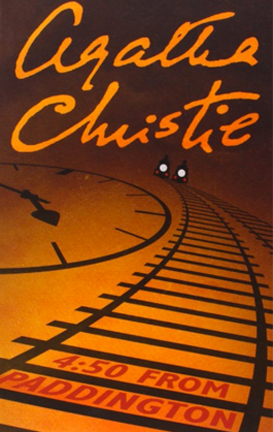
After all, she just had a quick glimpse (a snapshot-quick-in-a-blink-of-an-eye glimpse, at that) of what appeared to be a man strangling a woman. Elspeth was riding on a train and nearly lulled to sleep by the clackety clack of the train's wheels. Opening her eyes she notices another train traveling alongside but heading in the opposite direction than the one she was riding in. What Elspeth views in the window of the passing train causes her to snap to attention. A woman is being brutally strangled by a man. In a moment, the train was gone and even Elspeth isn't entirely convinced that what she saw was real. So, how can she report a murder if she can't even convince herself that she wasn't dreaming. No one would believe her fantastic story of seeing a murder actually being committed. No one except her good friend in St. Mary Mead, Jane Marple. Miss Marple is the one person that Elspeth knows she must confide in.
A good thing she did, too because when Miss Marple hears the tale she knows that the sensible Elspeth is telling the truth. After all, Elspeth is not the sort of woman to imagine things, so if she says she witnessed a murder then she must have done just that. Mulling the puzzle over in her head, Jane Marple concludes that a woman must have been murdered on the speeding train. But if she was murdered.... where is the body? No corpse has been discovered on the train and there has not even been a case of a missing woman reported to Scotland Yard.
Miss Marple first attempts to recreate the event from Elspeth's perspective. She travels on the same train and narrows the possibilities of what could have become of the murder victim. If the victim's body was not found on the train itself then there is only one logical answer... it was thrown from the moving train. In studying the path of the rail lines, Miss Marple deduces that the body must have been thrown from the train in a wooded area around Rutherford Hall, a large country estate owned by the powerful Crackenthorpe family.
While Miss Jane Marple has the brains to solve the crime, she feels that she is too elderly to take on the rigors of the case herself. So, she enlists the aid of Lucy Eyelesbarrow, a highly intelligent young women with an adventurous streak. Lucy, at Miss Marple's direction soon gains access to the crime scene by applying for the position as housekeeper at the Crackenthorpe estate. While Lucy does the strenuous legwork on location to ferret out a string of bewildering clues, Miss Marple advises her every move from behind the scenes to catch a murderer before he strikes again.
Agatha Christie created a unique partner for her popular Miss Jane Marple with Lucy Eyelesbarrow. In many ways she is a younger version of the aging spinster-sleuth. 4:50 from Paddington will keep readers guessing from page one and it is no wonder that this mystery was also translated to the big screen, as well as the smaller television screen. In 1961, the book was adapted into a feature movie starring Margaret Rutherford. More recently, 4:50 from Paddington was made into a television movie for British TV starring Joan Hickson who also completed a wonderful audio book based on the original mystery in 1994.
Read our biography of Agatha Christie.